What the AI tools did in 60 towns
I played the free-play town with the full waiting room sixty times, ten years each, with a few fixed plans, and counted the people who waited longer than the agreed limit for the hospital, out of all 5,000 residents. As detail I counted the months they spent on the list past it, the urgent patients among them, and the healthy years lost while waiting. The town follows Dutch rates for illness, referrals and deaths (see how close the town is to a real one), but the tools' effects are mine. The scheduling agent adds 30% to what the hospital can treat (the national capacity-planning model plan aims for 2% more productivity). The record link cuts the referrals that arrive without the GP's notes from 15 in 100 to 3 once every GP file in it is complete, and about 60 in 100 are on the day it goes live. Read the numbers as a comparison of plans in one town, not as what would happen in a real town.
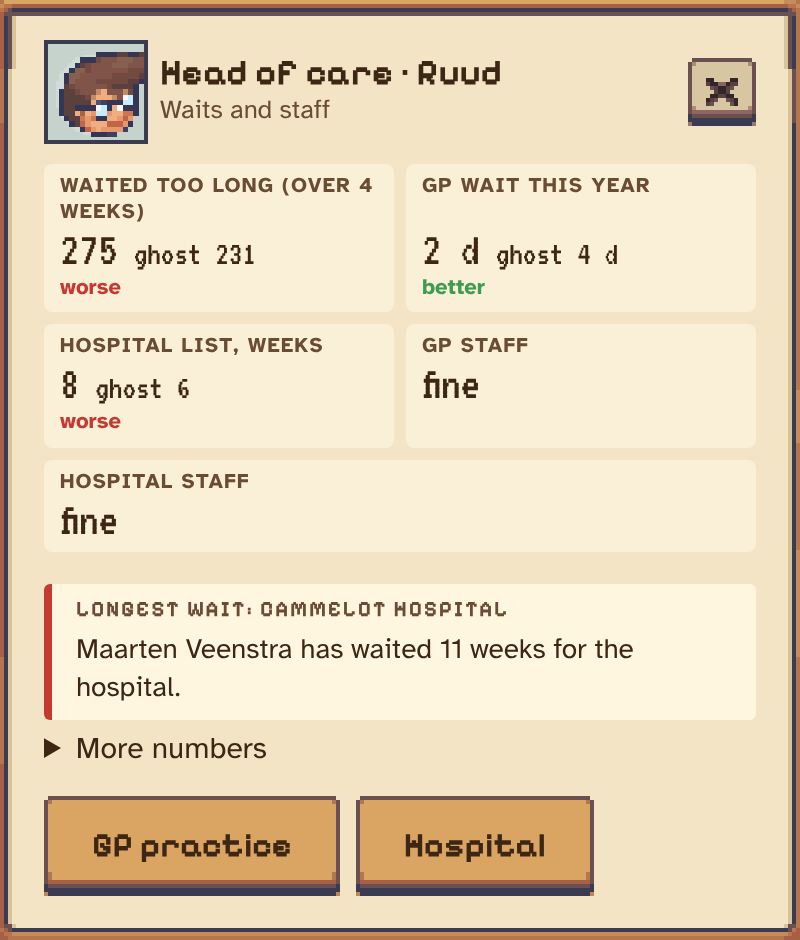
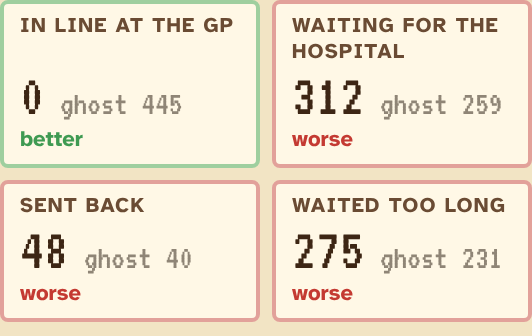
With nothing done, 12,105 people waited too long: 11,753 for a first hospital visit (over 4 weeks) and 352 for treatment (over 7 weeks), 457 of them urgent. Together they spent 6,667 months past the limit. An AI scribe on its own left 12,124 people who waited too long, slightly more, because the GPs send the extra people they see on to the same hospital. In the game the record link alone brought it to 6,109 (3,738 months past the limit), because referrals then reach the hospital with the GP's notes, and the record with the scheduling agent to 1,743 (2,138 months, 60 urgent).
Healthy years lost while waiting are an estimate. Every month on the hospital list costs part of a year in full health, more for a worn hip than for a heart check-up, from my reading of an English study (Gibbs et al. 2024, see Sources), with each resident's wait tied to one of their conditions by my own rule. All waiting for the hospital counts, not only the part past the limit. With nothing done the town lost 725 healthy years in ten years (581 to 840 at the low and high rates), with the scribe 735, with the record link 440 and with the record and the scheduling agent 155 (124 to 180). The game shows it next to Ghost Cammelot's: the number moves with the rates, and in the 60 towns the order of the plans was the same at the low and high rates.
Deaths linked to waiting are an estimate too, and small at Dutch rates: 0.7 in ten years with nothing done, 0.3 with the record and the scheduling agent. The game leaves them out and keeps them only here.
The triage agent on the record gives mixed results. It left 7,230 people who waited too long, more than the record alone, and 449 healthy years lost, about the same as the record alone. On months past the limit it left 3,551 on average, fewer than the record alone, but in 41 of the 60 towns it left more months, and a few towns where it helped a lot pull the average down. These counts include the people it wrongly tells "it's nothing". They wait at home for 10 days before they go to the GP, so their clock starts 10 days before the GP's referral, as if the agent had sent them on the day it answered.
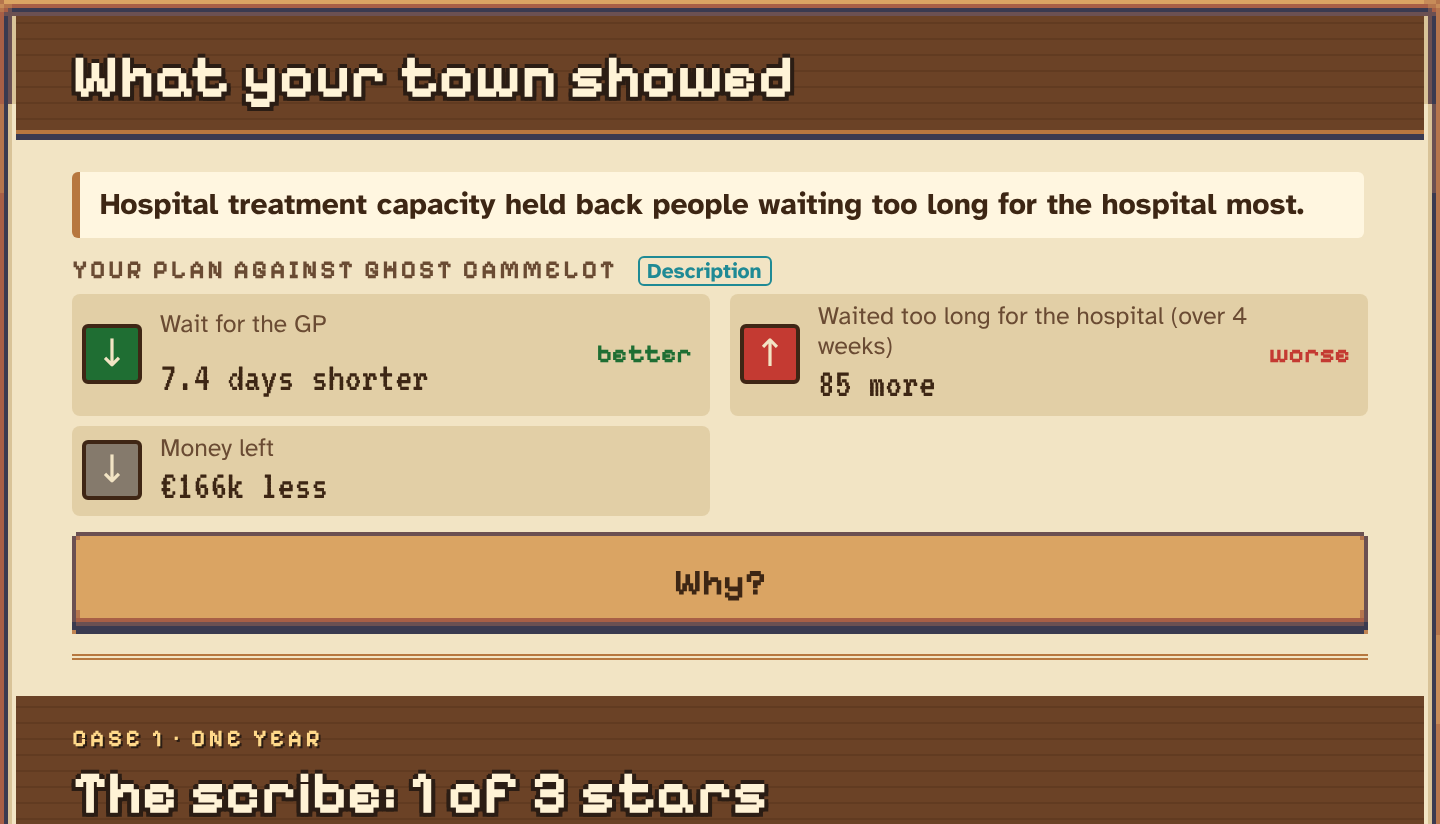
What mattered was which tool took load off the slowest line. In this town that is the hospital, so the scheduling agent helped most. Protected time for the doctors costs more than it saves here, because at Dutch rates the GPs rarely burn out. Each of the three plans here that built the record link left fewer people waiting too long than doing nothing.
With weaker effects, and other settings for the harm of waiting
I also played the same 60 towns with weaker effects. With the scheduling agent adding 10% instead of 30%, the record and the agent left 3,111 months, still fewer than the record alone (3,738); at the model plan's 2% it left 4,897, more than the record alone. Adding protected time for the doctors gave 3,847 at 10% and 6,277 at 2%. Buying everything at once left 4,480 at 10% and 5,613 at 2%, against 6,667 with nothing done. If the record only cuts missing notes to 10 in 100, the record alone left 5,907, not far from doing nothing, and the record with the triage agent 5,408. In every one of these the AI scribe on its own changed almost nothing.
The deaths linked to waiting rest on one assumption: 6% more risk of dying for every 4 weeks past the agreed limit. With 8%, the top of the range in the cancer study, the same waits give 0.9 deaths in ten years with nothing done and 0.5 with the record and the scheduling agent, against 0.7 and 0.3 at 6%. With no harm from waiting they are none, and the months of overdue waiting stay the same.
The lab tests whether an agent reads a referral right. The game shows what happens to the town when it does: an agent that reads every letter right can still make waits longer if the hospital behind it can't treat people any faster.